
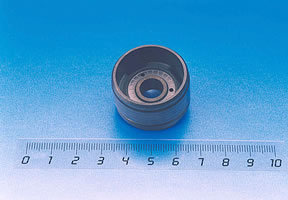
Compression molding compounds
Ceramer and Ceramerplus are ideal as reinforcing materials for PTFE and greatly improve abrasion resistance and creep tendency.
The particle shape, spherical with a rough, cracked surface, enables the material to form an intimate mechanical bond with matrix substances such as fluoropolymers.
The general outstanding chemical and temperature resistance of PTFE are not affected, as the properties of Ceramer and Ceramerplus are very similar to those of PTFE.
Due to the low density of Ceramer (1.44–1.54 g/cm³), a large volume load can be achieved with little weight gain. Ceramer is typically used as an additive in a range of 5–15 percent by weight. Ceramer and Ceramerplus can be processed under standard PTFE processing conditions such as compression molding powders or paste extrusion powders.
Extended applications through Ceramer
The enhancement of PTFE properties by Ceramer is very beneficial in automotive applications and in chemical processing technologies. In applications such as seals, bearings, gaskets and pump housings, Ceramer contributes substantially to tribological behavior and creep tendency without changing chemical resistance.
In other markets such as oil and natural gas, and food processing, PTFE/Ceramer bearings, seals and gaskets have offered superior performance — especially for parts facing high abrasion at high temperatures and in corrosive environments.
With Ceramerplus, a material is offered that further widens the range of applications, particularly for large-sized or extremely stressed parts.
Influence of Ceramer on abrasion and wear
Abrasion and wear of PTFE against metallic partners clearly show improved values, even at very low loading of Ceramer or Ceramerplus in PTFE. The coefficient of friction of PTFE is hardly changed by the addition of Ceramer and Ceramerplus.
The k-factor is a widely used term to describe abrasive properties (abrasion in mm/m divided by contact pressure in N/mm²). Results clearly demonstrate a significant reduction of the k-factor even at low filler content. Measurements were carried out with a pin-on-disc test instrument against hardened steel discs (100 Cr6, Rockwell hardness HRC > 50), technically dry, over a 20-hour test duration.
| Temperature [°C] | Contact pressure [N/mm²] | Sliding speed [m/s] | k-factor 0% Ceramer | k-factor 5% | k-factor 10% | k-factor 20% |
|---|---|---|---|---|---|---|
| 23 | 1 | 4 | 168 | 43 | 4.6 | 1.9 |
| 23 | 5 | 4 | 354 | 104 | 5.3 | 1.1 |
| 23 | 1 | 0.5 | 319 | 5.2 | 2.8 | 2.1 |
| 23 | 5 | 0.5 | 494 | 1.8 | 1.0 | 0.4 |
| 150 | 1 | 0.5 | 43 | 2.3 | 1.2 | 0.6 |
| 200 | 1 | 0.5 | * | 3.2 | 1.1 | 1.3 |
Influence of Ceramer on thermal expansion
Increasing amounts of Ceramer as reinforcing material in PTFE not only reduce the dependence of the coefficient of linear thermal expansion on temperature, but also lower its absolute value. This makes it much easier to dimension components whose shape will tend to change less with changing ambient temperatures.
| Ceramer content in PTFE [%] | 10–30 °C | 30–100 °C | 100–170 °C | 170–270 °C |
|---|---|---|---|---|
| 0 | 231 | 107 | 126 | 172 |
| 5 | 220 | 100 | 110 | 150 |
| 10 | 194 | 83 | 99 | 123 |
| 20 | 189 | 76 | 86 | 111 |
| 50 | 80 | 57 | 63 | 88 |
| 75 | 46 | 46 | 50 | 60 |
Density and mechanical properties
The density of Ceramer is approximately 1.44 g/cm³, of Ceramerplus approximately 1.54 g/cm³. Compared to fluoropolymers, whose density is above 2 g/cm³, the low density of Ceramer and Ceramerplus enables a high volume load with little weight gain and cost-effective material applications.
| Ceramer content in PTFE [%] | Density [g/cm³] | Tensile strength [N/mm²] | Elongation at break [%] |
|---|---|---|---|
| 0 | 2.17 | 29 | 380 |
| 5 | 2.08 | 17 | 470 |
| 10 | 1.96 | 18 | 400 |
| 20 | 1.90 | 13 | 300 |
Electrical properties
The electrical properties of PTFE are practically unaffected by the addition of Ceramer. The volume resistivity of PTFE and PFA (>10¹⁵ Ω·cm) stays at values above 10¹⁵ Ω·cm for compounds reinforced with 5%, 10% or 20% Ceramer.
The dielectric constant of PTFE compounds with Ceramer increases from 2.07 (pure PTFE) to 2.34 (20% Ceramer content) and is not affected by frequency.